Partners
4 min read
Build vs. buy is a horse race
At the gate, every firm looks the same. By the far turn, the field has split. Why building your own AI delivery stack costs more the further you run.
By
Joe Sinard

Picture the starting gate. Every horse is even, with the same distance, the same track and the same odds on the board.
That's where most systems integrators and advisory firms are with AI right now. Everyone has licenses for Claude, ChatGPT or Copilot. Everyone has a few consultants writing great prompts, and some firms have started building internal tools to tie it all together. From the grandstand, the field looks level.
It won't stay that way, and the reason is your clients.
The track is changing
Enterprises are rethinking what transformation means. Instead of one large program every few years, AI-native companies want to understand and improve themselves continuously. That changes what clients value from a partner: less of a binder handed over at the end, and more connected knowledge the business can keep using.
The firms that win the next decade will be the ones whose work keeps paying off for the client after go-live.
The case for building
Building has a real pull. The licenses are already paid for. Your team knows your methodology better than any vendor does, and you own the IP. One sharp consultant with a good prompt can produce a status report in minutes instead of hours.
All of that is true. But it's only the first furlong.
What happens on the backstretch
The cost of building shows up later, and it compounds.
Every tool you build is a product you now maintain. Delivery stacks add a tool for each phase. If every tool connects to every other one, 14 tools need 91 connections, and any update can break one. Your senior consultants become the integration layer.
DIY AI makes one person faster, not the practice better. Prompts live in personal accounts and project history lives in personal folders. There's no shared model, no audit trail of decisions and no consistency from one engagement to the next.
When that consultant leaves, the advantage leaves with them.

Meanwhile, a firm on a purpose-built platform spends its energy on delivery, and the platform improves on someone else's R&D budget. So ask yourself: what does your R&D roadmap look like in two years, and do you want to own one at all?
Why the gap widens
The gains aren't linear. A firm that builds gets a one-time lift, then spends money to maintain it.
A firm on a shared platform gets a lift that compounds. Project ten benefits from projects one through nine. New consultants start with the firm's playbook, not a blank page. And the client keeps a living record of the work, which is the strongest reason to bring that partner back.
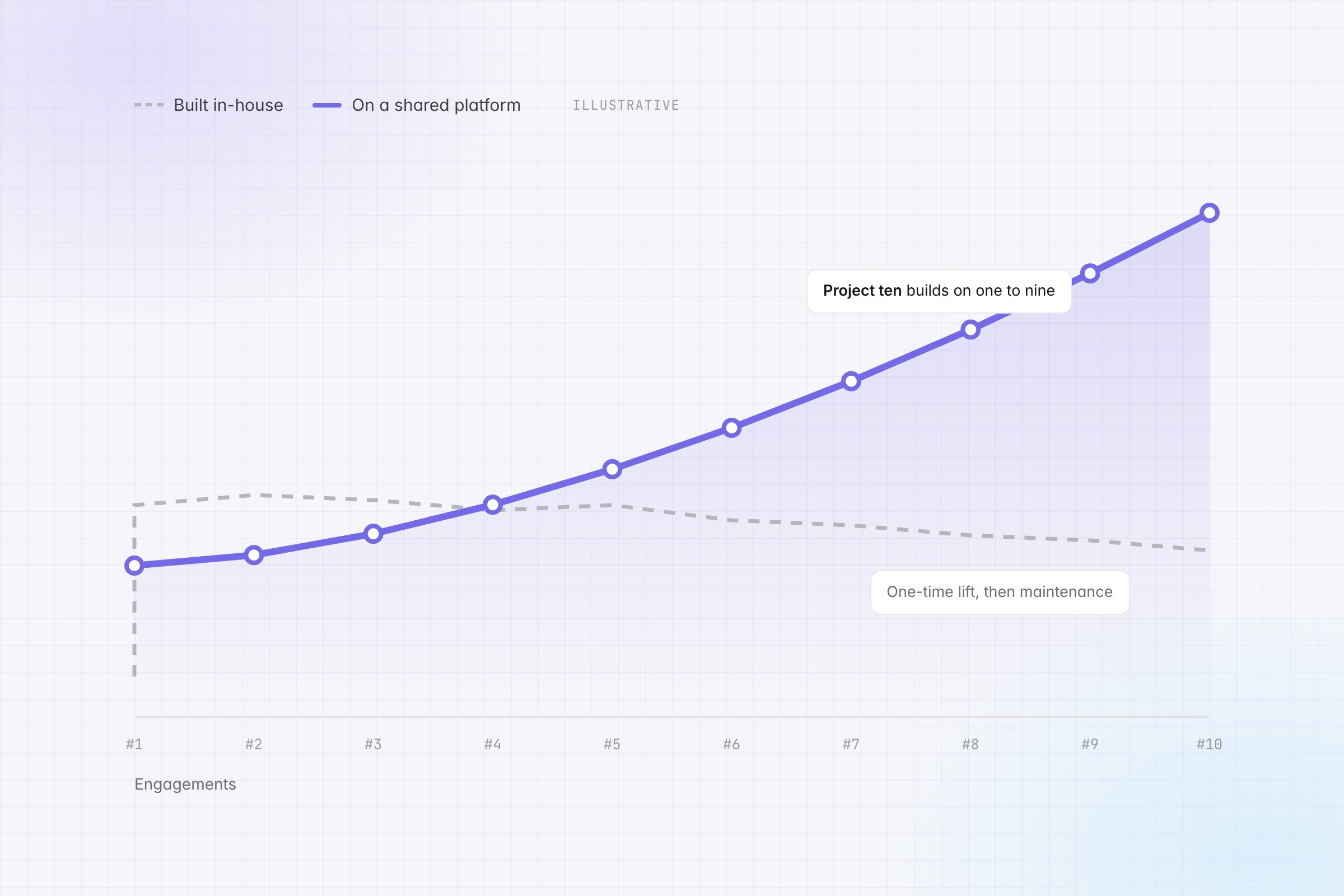
At the gate, both horses look the same. By the far turn, one is carrying the weight of everything it built and now has to maintain. The other is running light, with the whole stable behind it.
A question for every practice leader
The real question isn't "Can we build it?" Most good firms can. The question is whether you want to be in the software business or the transformation business.
If your best PM left tomorrow, would their prompts and project history stay with the firm?
How many tools does a PM touch to answer "What changed this week, and who approved it?"
Who will maintain the internal tool 18 months from now, and what billable work will they give up to do it?
Where Transform fits
Transform is the enterprise AI platform that connects company knowledge, systems, conversations and operational data, so people and AI teammates can understand the business and get work done.
For partners, that means the engagement runs on the same platform the client keeps. Your methodology lives in the platform, not in a deck, and your work becomes part of how the client runs.
Build what makes your firm different: your methodology, your expertise and your client relationships. Don't build the track. Race on one built for you.
Meet us at SuiteWorld, October 25 to 28, or visit our partners page.

The enterprise AI platform that understands your business and gets work done.